Childbirth Preparation Classes in France: What to Expect
This post is part of my Pregnant in France series. Start with Just Found Out You’re Pregnant in France?
One of the things that surprised me most about being pregnant in France was how structured and generous the preparation support is. Seven childbirth preparation classes, covered entirely by the Assurance Maladie, with a midwife or doctor guiding you through everything from breathing techniques to what happens in the delivery room. For free. No catch. If you are pregnant in France and wondering what these classes involve, how to find them, and what to expect, this post covers everything.
What Are the 7 Childbirth Preparation Classes?
The séances de préparation à la naissance et à la parentalité are seven sessions offered to all pregnant women in France as part of the standard prenatal care package. They are led by a sage-femme (midwife) or a doctor and are designed to prepare you practically and emotionally for labour, delivery, and the early weeks with a newborn.
They are covered 100% by the Assurance Maladie, provided the sessions are conducted by a registered sage-femme or doctor. There is nothing to pay upfront and nothing to claim back, the coverage is automatic once your pregnancy is declared.
Important note: The 7 classes come after the entretien prénatal précoce (early prenatal interview), which is a separate session held around the 4th month of pregnancy. The EPP is where you and your midwife discuss your pregnancy and plan the 7 sessions together.
When Do the Classes Start?
The classes typically begin from your 7th month of pregnancy, though some midwives start from the 6th month. They usually run over 6 to 8 weeks at a frequency of one session per week, though this varies depending on your midwife and your availability.
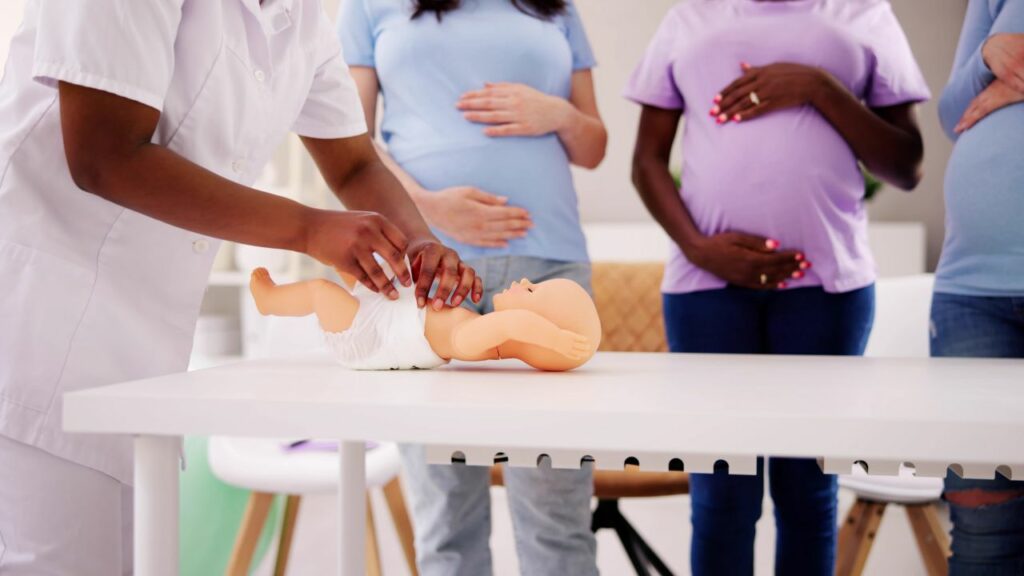
Each session lasts approximately one hour, sometimes up to an hour and a half for individual sessions. Groups are usually small, typically three pregnant women maximum per session, which makes for a genuinely intimate, practical experience rather than a lecture.
My own classes were held weekly with a local midwife at her clinic in the suburbs. She had recommended I find someone close to home rather than stay with my Paris midwife, partly for practicality during the later stages of pregnancy, and partly because local midwives can also do the home visits and post-birth périnée rééducation afterwards.
Who Leads the Classes and Can You Choose?
You can take your classes with the professional who follows your pregnancy, or with a different sage-femme entirely. The choice is yours. To be reimbursed at 100%, the sessions must be led by a registered doctor or sage-femme, but beyond that, you have flexibility.
Most women in France do their classes with a sage-femme libérale, an independent midwife working from a private clinic or coming to your home. You can also take classes at your registered maternité, though spots are limited and priority is often given to first-time mothers.
Tip: Use Doctolib to search for “préparation à la naissance” near your address. You can filter by availability, see the types of preparation offered, and book directly online. This is by far the easiest way to find a local sage-femme with available slots.
Can Your Partner Attend?
Yes! And it is strongly encouraged. The father or co-parent is welcome at most of the sessions, particularly those covering labour techniques, breathing exercises, and delivery. These are the sessions where having a support person who has actually learned the techniques makes a real practical difference.
There are one or two sessions that are typically just for the expecting mothers, usually those focused on the physical aspects of late pregnancy and postpartum recovery. Your midwife will let you know in advance which sessions your partner is invited to.
It is very informative for both soon-to-be parents to be involved. One can learn to recognise signs and actively support the other during labour in ways that go far beyond just being present.
What the 7 Sessions Cover
The content varies slightly between practitioners and formats, but a standard programme covers the following across the seven sessions (these are in no particular order and the instructor can go at their pace):
Session 1: End of Pregnancy and Start of Labour
- Overview of the final weeks of pregnancy
- Signs that labour has begun: contractions, waters breaking, when to go to the maternité
- Monitoring methods and induction
Session 2: Breathing, Relaxation & Posture
- Breathing exercises for pregnancy and labour
- Relaxation and meditation techniques
- Positions and postures to manage late pregnancy discomfort
- Managing common pregnancy aches, back pain, pelvic pressure
Session 3: Pain Management
- Pain management options: support positions, massage, breathing, balloon
- Epidural anaesthesia: how it works, when it is offered, what to expect
- Alternative approaches: sophrologie, hypnobirthing, homeopathy
- For those planning an unmedicated birth: specific techniques including the Bonapace method
Session 4: Pushing and Delivery Positions
- Delivery positions used in French maternités
- Pushing techniques
- Understanding forceps, vacuum extraction, and emergency versus planned césarienne
- Roles of each member of the medical team during delivery
Session 5: Welcoming the Baby
- Immediate newborn care at the maternité
- Weight monitoring, jaundice, temperature, cord care
- Early days: crying, sleep, baby development
Session 6: Postpartum for the Mother
- Your hospital stay after the birth: what to expect
- Return home: practical preparation, new rhythms with baby
- Périnée rééducation: what it is, when it starts, why it matters
- Sexuality and contraception after birth
- Postpartum follow-up with your sage-femme at home
Session 7: Feeding and Baby Care
- Breastfeeding: how to start, common challenges, support available
- Bottle feeding: formula options, preparation, frequency
- Practical baby care: bathing, nappy changes, soothing techniques
Types of Preparation Available
The standard program is what is covered at 100% by the Assurance Maladie. But many sage-femmes also offer complementary approaches, either as part of the standard sessions or as optional extras:
- Classical preparation: the standard program described above, mixing theory, practical exercises, and group discussion
- Sophrologie: relaxation and visualisation techniques added to the standard sessions, often 15–20 minutes at the end of each class
- Yoga prénatal: gentle movement adapted to pregnancy, increasingly offered as part of or alongside the standard sessions
- Aquaprénatal: preparation in a heated pool, blending the standard content with water-based movement. Usually involves an additional cost not fully covered by the Assurance Maladie, though some mutuelles contribute
- Haptonomie: a method focused on prenatal bonding and conscious contact with the baby, often done as a couple
Your Assurance Maladie covers the standard 7 sessions. For anything beyond that, check with your mutuelle before booking, many top up for alternative methods, particularly sophrologie and yoga prénatal.
What If You Can’t Find Local Classes or Prefer Online?
Finding a sage-femme with available slots can be genuinely difficult, particularly in some areas of Île-de-France and in smaller towns. If your local options are limited, or if your schedule, bedrest, or distance makes in-person attendance difficult, online options exist.
Some sage-femmes offer the standard preparation sessions via video call, which are still reimbursable by the Assurance Maladie provided they are conducted by a registered practitioner. Ask your midwife or CPAM directly about what is covered in your specific situation.
There are also online video course platforms offering preparation content in French, created by qualified sage-femmes. These are not covered by the Assurance Maladie but can be a useful supplement, particularly for English-speaking expats who want to understand the content in advance before attending French-language group sessions.
For expats in the suburbs: If you are in the western suburbs of Paris like me, your Paris-based doctor or midwife may recommend finding a sage-femme libérale closer to home, both for the preparation classes and for the post-birth home visits and périnée rééducation. Doctolib is your best starting point for finding someone local with availability.
How to Find Your Childbirth Preparation Classes
There are three ways to find your classes:
- Ask your sage-femme or doctor. If they offer the classes themselves they will tell you. If not, they will likely have local recommendations.
- Contact your registered maternité. Most maternités offer their own preparation program. Availability varies and spots fill early, so enquire as soon as your place is confirmed.
- Search Doctolib. Search “préparation à la naissance” with your postcode to find independent sage-femmes near you with available slots. You can filter by preparation type and book directly.
Do not leave this too late. Sage-femme slots fill quickly, particularly in and around Paris. Aim to have your classes planned by the time you reach your 6th month.
What Comes Next in the Series
The childbirth preparation classes are one part of a well-structured pregnancy journey in France. The rest of this series covers:
- Declaring your pregnancy in France: the first administrative step that unlocks all your benefits
- The entretien prénatal précoce:the early prenatal interview held around the 4th month
- Your first trimester appointment: what to expect at the premier examen prénatal
- Congé maternité explained: how maternity leave works in France


You May Also Like
Maternity Leave in France: Your Guide to Congé Maternité
9 March 2025
Miscarriage in France: What to Expect and Your Rights
23 October 2024