How to Apply for French Sécurité Sociale as a Foreigner

This post is the first part in my series to navigating the French healthcare system as an expat. Check back often—I’m adding new guides regularly to make French healthcare a little less confusing!
One of the first things you will want to sort out when you arrive in France is your healthcare coverage. France has a universal system called securite sociale, and if you are legally residing here, you are almost certainly entitled to join it. The process is not fast and the paperwork is not light, but once you are in the system, you have access to one of the best healthcare systems in the world.
I applied as the spouse of a French national, so that is the experience at the centre of this guide. I have also included a visa eligibility table covering the most common situations, because the path in is slightly different depending on your status.
Table of Contents
CPAM, Sécurité Sociale, and Ameli: What Is What
These three terms come up constantly and are easy to confuse, so let’s clear them up before anything else.
Sécurité sociale is the overall system; France’s national framework for health insurance, pensions, family benefits, and more. It is the umbrella under which everything sits.
CPAM (Caisse Primaire d’Assurance Maladie) is your local health insurance office. This is the specific branch of sécurité sociale that manages your healthcare coverage, your carte vitale, and your reimbursements. When you apply for health coverage as a foreigner, you are applying to your local CPAM.
Ameli is your online account. Once your registration is processed and you have a social security number, you create an Ameli account to manage everything: order your carte vitale, download your attestation de droits, track reimbursements, and update your information.
In short, sécurité sociale is the system, CPAM is the office that handles your health coverage, and Ameli is how you manage it online.
The Five (Plus One) Branches of Sécurité Sociale
Sécurité sociale is not just healthcare, it covers several aspects of life in France. Here is a quick overview of what the system includes.
L’Assurance Maladie (Health Insurance)
The branch most people mean when they say sécurité sociale. Managed by CPAM, it covers doctor visits, hospital care, prescriptions, medical tests, maternity care, and some mental health support. It reimburses up to 70% of most costs. The remaining 30% is typically covered by a mutuelle, a top-up insurance either provided by your employer or purchased privately.
L’Assurance Vieillesse (Old-Age Insurance)
Tracks your working life and contributions so you can receive a state pension when you retire. Also provides survivor pensions for widows and widowers, and disability pensions.
L’Assurance Accidents du Travail / Maladies Professionnelles
Covers workplace accidents and job-related illnesses. Provides 100% medical coverage and income replacement if you are injured on the job or become ill as a result of your work.
La Branche Famille (Family Benefits)
Managed by CAF (Caisse d’Allocations Familiales). Covers birth and adoption benefits, monthly child allowances, parental leave payments, housing assistance (APL), childcare subsidies, and support for single parents and low-income families.
La Branche Recouvrement (Collection Branch)
Run by URSSAF. This branch collects the social contributions (cotisations sociales) from employers and the self-employed that fund the entire sécurité sociale system.
La Branche Autonomie (Autonomy Branch)
A sixth branch introduced in 2021, still developing. Focuses on helping elderly and disabled people maintain their independence at home or in care facilities.
PUMA: The Access Gateway
Before you can access sécurité sociale as a foreigner, you need to understand PUMA, the Protection Universelle Maladie. Introduced in 2016, PUMA is the system that guarantees anyone living legally in France on a stable and regular basis the right to healthcare coverage through the state, regardless of employment status.
When you apply for sécurité sociale as a new arrival, you are essentially applying for coverage under PUMA. The two terms are used almost interchangeably in practice.
To qualify for PUMA you must: be living in France legally (visa, residency permit, or another valid status), have been continuously resident in France for at least 3 months, and not already be covered by foreign employer insurance or another health system.
A note on costs: PUMA is free for most people. However, non-working residents above a certain income threshold (such as early retirees or non-working spouses with capital income) may be subject to a social contribution called the CSM (cotisation subsidiaire maladie). This only applies if your income from capital is above a set level and you are not already contributing to the system through work.
Who Can Apply and When
In general, anyone legally residing in France on a long-term basis who is not already covered by a foreign employer’s insurance can apply for sécurité sociale. The three key factors are your residency duration, your visa type, and your proof of stable residence in France.
As the spouse of a French national on a VLS-TS VPF, I was eligible from the day I validated my visa, no three-month wait required. Your timeline will depend on your own situation. The table below covers the most common cases.
Who can apply and when you're eligible
In general, anyone legally residing in France on a long-term basis and not already covered by another system (like an employer’s foreign insurance) can apply for sécurité sociale. The key factors for application are residency duration, visa type, and proof of stability in France. The following table lists the different types of visas and their eligibility and time line to apply.
Sécurité Sociale Eligibility by Visa Type
| Visa/Status Type | Eligibility | Notes |
|---|---|---|
| VLS-TS (Student) | ✅ Yes | Apply via student pathway; student-specific coverage often begins upon enrollment. Registration via etudiant-etranger.ameli.fr. |
| VLS-TS (Employee/Salaried) | ✅ Yes | Employer typically registers you; you can also apply independently as soon as you start working. |
| VLS-TS (Visitor) | ✅ Yes | Must prove stable residence; apply under PUMA if not employed, can apply after 3 months continuous legal residence in France. |
| VLS-TS (Spouse of French citizen) | ✅ Yes | Eligible upon visa validation. |
| Talent Passport (e.g. entrepreneur, artist) | ✅ Yes | Covered under employment/self-employment pathways, eligible through URSSAF. |
| Carte de séjour temporaire/pluriannuelle | ✅ Yes | For students, workers, family members, etc. |
| Carte de résident (10-year resident card) | ✅ Yes | Full access to health coverage. |
| EU/EEA/Swiss citizens | ✅ Yes | Can after 3 months of continuous residence (unless employed, then immediately). |
| Refugee/Subsidiary protection status | ✅ Yes | Eligible for full coverage upon recognition. |
| Asylum seekers | ⚠️ Limited (via AME) | Covered under AME or specific asylum provisions. |
| Au pair visa | ⚠️ Possibly (case by case) | Depends on agreement and prefecture; host family may assist |
| Short-stay visa (visa court séjour) | ❌ No | For stays under 90 days—no eligibility. |
| Tourist/visa-free stays (e.g. U.S. 90-day rule) | ❌ No | Not eligible for sécurité sociale coverage. |
What Documents You Will Need
The second page of the application form lists the specific documents required for your situation. The following is the general list as you may not need all of these and/or you may be asked for additional items depending on your case.
- Completed application form Cerfa n° 15763*02 : available to download from ameli.fr or service-public.fr. Fill in your full name, address, date of arrival in France, marital status, and dependents.
- Proof of identity: valid passport including your VLS-TS or titre de sejour. If you do not yet have a titre de séjour, include proof of visa validation.
- Birth certificate: the long-form version showing your parents’ names. If not in French, you will need a certified translation from a traducteur assermente (sworn translator). I use Bilingual Minds for all my translation purposes.
- Proof of address in France: a utility bill (electricity, gas, internet) in your name, a quittance de loyer (rent receipt), a rental contract, or an attestation d’hebergement if someone is housing you (plus their ID and utility bill).
- Proof of 3 months’ residence (if your situation requires it): at least 3 months of dated documents confirming your residence in France: utility bills, bank statements, or housing contracts.
- Proof of activity depending on your status.
If employed: employment contract (CDD or CDI) and first pay-slips.
If self-employed: SIRET number or KBIS, declaration of activity with URSSAF, invoices or proof of income.
If a student: certificat de scolarité, valid student visa, student housing or CROUS documents.
If a spouse or dependent: marriage certificate, proof of spouse’s legal residence and activity, birth certificates for children if applicable.
If unemployed or not working: bank statements showing sufficient financial resources, and proof of private health insurance if you have it.
RIB (Relevé d’Identité Bancaire): your bank account details, so reimbursements can be paid directly to you once your account is active.
How to Submit Your Application
Most foreigners apply through their local CPAM (Caisse Primaire d’Assurance Maladie). You can submit your dossier by post or drop it off in person at your local office.
If mailing your application, always send it by LRAR (lettre recommandée avec accusé de réception), registered post with acknowledgment of receipt. This gives you a time-stamped proof that CPAM received your dossier, which matters if anything goes wrong later.
If you are in Paris, send your dossier to:
Assurance Maladie de Paris
75948 PARIS CEDEX 19
If you are outside Paris, use the CPAM office finder at ameli.fr to locate where to send your dossier. You can also find information about your local CPAM on service-public.fr.
If you have questions at any point, call 3646, free from French phone numbers. Some CPAM offices offer English-language assistance but it varies, so do not count on it.
What Happens Next and How Long It Takes
Once you have submitted your application, here is what to expect.
You will first receive a temporary social security number, which begins with an 8. In my case I did not receive an official document stating the number; instead I got a letter reminding me to declare a médecin traitant. Once you have your temporary number you can start making medical appointments and picking up prescriptions. Let your doctor or pharmacist know in advance that you are using a temporary number while your account is being opened.
Since you cannot request your carte vitale yet, you will need to ask for a feuille de soins at each appointment and submit these manually to your CPAM for reimbursement.
The full timeline from submission to permanent number is typically 4 to 6 months. Expect 2 to 3 months from submission to temporary number, then another 2 to 3 months for your permanent number to come through.
What to Do While You Wait
There is not a lot you can do except stay organized and patient. If you reach the 3-month mark with no movement, call 3646. If you are not comfortable speaking French on the phone, ask a friend to make the call for you.
Go to medical appointments if you need to but be prepared to pay out of pocket. Always ask for a feuille de soins after each visit so you can submit it for retroactive reimbursement once your number is active. Save every receipt and keep copies of everything, physical and digital, before you send anything off.
As soon as you have your official number, request your attestation de droits from your Ameli account. This document proves you are covered while you wait for your Carte Vitale to arrive, and you will also need it to apply for a mutuelle.
Applying for Your Carte Vitale
Once you have your official social security number and have created your Ameli account, you can request your carte vitale online. Log into ameli.fr, go to Mes Demarches in the top menu, and click Commande de Carte Vitale. Have a passport-style photo ready in digital format, along with a copy of your ID. Submit the request and your card typically arrives within 2 to 4 weeks.
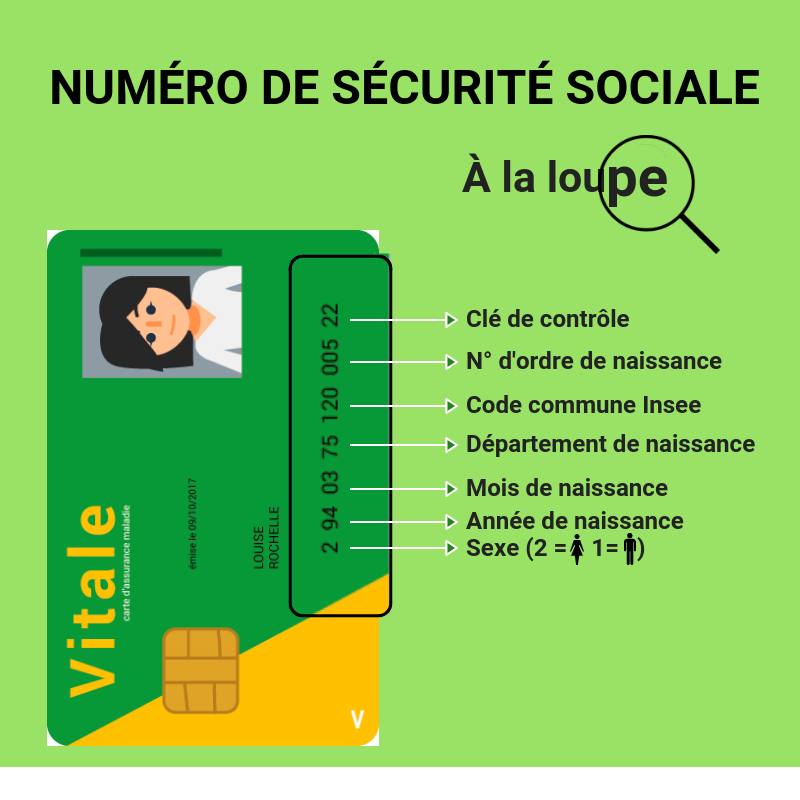
A note on your social security number: it is a 13-digit number followed by a 2-digit control key. The first digit is your gender (1 for male, 2 for female). The next two digits are your birth year. The following two are your birth month. The next five digits indicate your place of birth — if you were born abroad, the first two will be 99, followed by the three-digit INSEE country code. The final digits are your birth order number and control key.
Tips, Mistakes to Avoid, and My Personal Timeline
- Always send by LRAR. Every single time you mail anything to a government office, send it registered with acknowledgment of receipt.
- Make copies of everything before you send it, physical and digital. You will thank yourself later.
- You can use the system before your carte vitale arrives. Just ask for a feuille de soins at every appointment and save every receipt for manual submission.
- Request your attestation de droits the moment you have your number. You need it to prove coverage while waiting for the card, and to sign up for a mutuelle.
- To create your Ameli account, you should receive a temporary code by post. If it does not arrive (it did not for me), call 3646 and they will send a code by SMS.
- If your preferred CPAM does not have English speakers, prepare a few key phrases in advance. See the vocabulary section below.
My personal timeline:
- May 14, 2020: sent application with documents to Assurance Maladie by post.
- June 16, 2020: received letter with my temporary social security number and a reminder to declare a médecin traitant.
- July 20, 2020: called 3646 to get login code for Ameli. Ordered carte vitale online.
- July 22, 2020: received letter confirming my official permanent number and notification that I could apply for my carte vitale.
- August 7, 2020: carte vitale arrived in the post.
Total time from application to carte vitale in hand: approximately 4 months. This was during Covid, which may have affected processing times in either direction.
Useful Phrases for Calling CPAM
- Est-ce que mon dossier a bien ete reçu? — Has my file been received?
- Quels documents sont manquants? — What documents are missing?
- Je voudrais savoir ou en est mon dossier. — I would like to know the status of my file.
- Je n’ai pas encore reçu de reponse, est-ce normal? — I haven’t received a response yet, is this normal?
- J’aimerais obtenir une attestation de droits. — I’d like to request a certificate of coverage.
- Je n’ai pas encore reçu ma carte vitale. — I haven’t received my carte vitale yet.
- Comment puis-je demander une carte vitale? — How can I request a carte vitale?
- Je souhaite créer mon compte Ameli. — I’d like to create my Ameli account.
- Je suis en attente de mon numero definitif. — I am waiting for my permanent number.
Useful Vocabulary for Sécurité Sociale
| French Term / Phrase | English Meaning / Explanation |
|---|---|
| Sécurité sociale | France’s public health insurance system that reimburses medical costs |
| Numéro de sécurité sociale | Social security number used to track healthcare and benefits |
| Carte Vitale | Health insurance card used for medical appointments and reimbursements |
| Remboursement | Reimbursement of medical expenses by Social Security |
| Ticket modérateur | Portion of medical costs not covered by Social Security |
| Affiliation | Enrollment or registration in the Social Security system |
| CPAM (Caisse Primaire d’Assurance Maladie) | Local office that manages health insurance claims and reimbursements |
| Assuré(e) | Person covered by Social Security |
| Ayant droit | Dependent covered under someone else’s Social Security (e.g., child) |
| Médecin traitant / médecin référent | Primary care doctor who coordinates care for optimal reimbursement |
| Parcours de soins coordonné | Coordinated care pathway required for maximum reimbursement |
| PUMA (Protection Universelle Maladie) | Universal health coverage for residents in France |
| Hospitalisation | Hospital stays and related medical care |
| Soins courants / soins de ville | Routine or outpatient care (doctor visits, lab tests, etc.) |
| Maternité | Pregnancy and maternity-related care |
| Invalidité / handicap | Disability-related coverage |
| Maladie professionnelle / accident du travail | Coverage for work-related illness or injury |
| Feuille de soins | Paper claim form submitted if the doctor does not use Carte Vitale |
| Télétransmission | Electronic transfer of medical claims to Social Security for reimbursement |
| Taux de remboursement | Percentage of medical costs covered by Social Security |
| Mutuelle / complémentaire santé | Supplementary insurance to cover costs not reimbursed by Social Security |
| CSS (Complémentaire santé solidaire) | State-supported health coverage for low-income residents |
| Aide / subvention | Assistance or subsidy available to help with healthcare costs |
| Je souhaite m’inscrire à la Sécurité Sociale. | I’d like to register for Social Security |
| Quel est le taux de remboursement ? | What percentage of costs will be reimbursed? |
| Quels documents sont nécessaires ? | What documents are required? |
| Puis-je utiliser ma Carte Vitale immédiatement ? | Can I use my Carte Vitale immediately? |
Resources
Ameli (create account, order Carte Vitale, download attestation)
Cerfa 15763*02 application form
CPAM Paris mailing address: Assurance Maladie de Paris, 75948 PARIS CEDEX 19
CPAM helpline (free from French numbers): 3646
Carte Vitale in France: Everything You Need to Know


You May Also Like

Due Date in France: How It’s Calculated & What to Expect
16 May 2025
Having a Baby in France as an American – The Full Guide
14 July 2026
5 Comments
Pingback:
Pingback:
Pingback:
Pingback:
Pingback: