Certificat de Capacité à Mariage: Step One in the French Marriage Process
Last updated: 16 May 2026
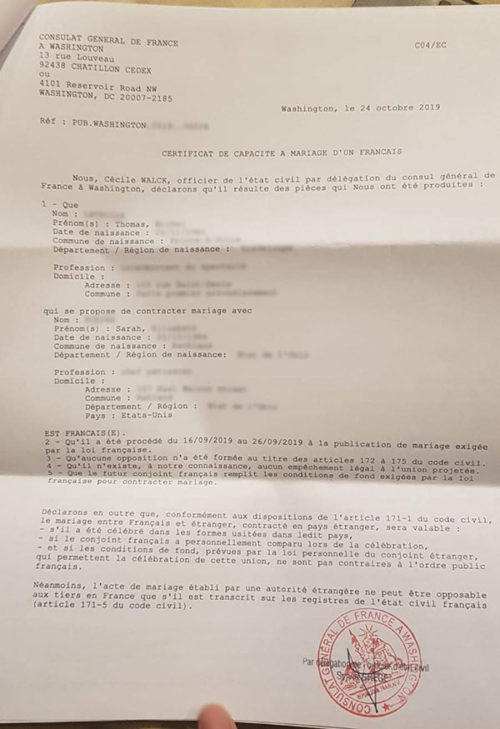
If you landed here from the main post, you already know the shape of this journey. This is where it officially begins, not with rings or venues or save the dates, but with a form, a consulate, and a trip to the local mairie.
Step One belongs entirely to your French partner.
What is the Certificat de Capacité à Mariage?
The certificat de capacité à mariage is an official document issued by the French government that confirms your French partner is legally free to marry. It is required any time a French citizen marries abroad, and without it, your marriage will not be recognised in France.
Part of this process involves something called the publication des banns. France is one of the few countries that still practices this tradition. For ten days, the announcement of your upcoming marriage is posted at your French partner’s local mairie, during which time anyone with a legal objection, an existing marriage, a family relationship, a question of consent, can come forward.
It sounds medieval. It is actually rather thorough. And it is not optional.
Once the banns have been posted without objection, your partner will receive the certificat. In our case, the process took the full eight weeks, which is exactly what they quote. My husband received the certificat 18 days after the banns were successfully posted so factor that into your timeline as well. The moment it arrived in the mail, he booked his plane ticket.

I would not have known this process existed at all without my friend Berry, who had just gone through it herself for her own marriage. We set out from day one to do everything by the book, because we knew that any step missed could add months to our timeline. It paid off.
Timeline note: Start this process at least three months before your intended wedding date. Between gathering documents, mailing the dossier, the bans posting period, and processing time, eight weeks is a realistic minimum. If an audition (interview) is requested by the consulate, allow more time.
Where to Apply
Your French partner will need to apply through the French consulate that covers your region in the US. For us, everything went through the French Consulate of Washington D.C. We were able to find a website that detailed the process and also had the necessary application forms.
The application form is in French and is submitted on behalf of your French partner. When in doubt about which consulate to contact, check the official French government website at service-public.fr for the most current guidance, as processes and contact details do change.
France maintains ten consulates general in the United States. The table below shows which consulate is responsible for each state and territory.
What If Your French Partner Is Still Living in France?
The consulate table below applies to French nationals who are already living in the United States at the time of the application. If your French partner is still living in France, as my husband was when we got engaged, the process works a bit differently.
According to the French government, a French national with a domicile or residence in France handles the publication des bans through their local mairie in France, not through a US consulate. That is exactly what my husband did. He submitted his dossier directly to his mairie in Paris, the bans were posted there, and the certificat was issued through that process.
If you are not sure which route applies to your situation, or if your French partner splits time between France and the US, contact the French consulate that covers your wedding location directly. They are the authoritative source for your specific case.
French Consulate Jurisdictions in the United States
Consulate | States / Territories Covered |
Atlanta | Alabama, Georgia, Mississippi, North Carolina, South Carolina, Tennessee |
Boston | Maine, Massachusetts, New Hampshire, Rhode Island, Vermont |
Chicago | Illinois, Indiana, Iowa, Kansas, Kentucky, Michigan, Minnesota, Missouri, Nebraska, North Dakota, Ohio, South Dakota, Wisconsin |
Houston | Arkansas, Oklahoma, Texas |
Los Angeles | Arizona, Colorado, New Mexico, Southern California, Southern Nevada |
Miami | Florida, Puerto Rico, the Bahamas, Cayman Islands, Turks & Caicos, U.S. Virgin Islands |
New Orleans | Louisiana |
New York | Connecticut, New Jersey, New York, Bermuda |
San Francisco | Alaska, Northern California, Hawaii, Idaho, Montana, Northern Nevada, Oregon, Utah, Washington, Wyoming, Guam, American Samoa |
Washington, DC | Delaware, Maryland, Pennsylvania, Virginia, Washington DC, West Virginia |
California and Nevada are split: Northern California and Northern Nevada fall under the San Francisco consulate. Southern California and Southern Nevada fall under the Los Angeles consulate. If you are marrying near the dividing line, verify directly with the consulate which jurisdiction applies.
A Note on Contacting the Consulate
Most consular procedures require an appointment. Do not send documents without first contacting the consulate to confirm the current process and ask for the most up-to-date checklist. Procedures, required forms, and accepted document formats can change, and the consulate’s own guidance will always take precedence over anything you read online — including this post.
For administrative questions (passports, civil status, nationality), the French government also operates a dedicated information service called France Consulaire, available Monday to Friday during Paris business hours. Each consulate’s website lists the France Consulaire phone number for their time zone.
What You Will Need
Read this list carefully and then read it again. “When in doubt, apostille it” became my personal motto during this process and I stand by it.
For Your French Partner
- A complete copy of their birth certificate, issued within the last three months from the mairie where they were born.
- A photocopy of both sides of their national ID card or passport.
- The completed questionnaire; two copies are included in the application PDF (see Resources below).
- Proof of address (a phone bill, electricity bill, or proof of rent).
- If applicable: proof of marital status (for example, a divorce decree).
For You (the Non-French Partner)
- A sworn statement; the form is provided in the application PDF.
- A certified and apostilled original copy of your birth certificate, issued within the previous six months.
- A photocopy of your passport ID page.
- Proof of address.
- If applicable: proof of marital status.
Important: The consulate may request additional documents depending on your individual situation. They may also request an audition, an interview with both partners, before the bans are published. This is used to verify that the marriage is genuine and consistent with French law. If an audition is requested, it will add time to the process, so build that buffer into your timeline.
A Word on Apostilles
An apostille is a certification that validates the origin of a document, the signature or seal of the person who signed it, and the manner in which it was produced. It is what makes your American documents legally valid in France.
Each US state has its own apostille process. Check your state’s Secretary of State website for the current procedure, fees, and turnaround time. Some states offer expedited processing; others do not. Order your apostille after you have your final document in hand, apostilles are date-sensitive and tied to a specific document.
A Word on Birth Certificates
Ohio changed the format of their birth certificates and eliminated certain fields. The first copy I sent did not include my city of birth and was sent back. I had to obtain a copy of my original birth certificate that contained the required information. Check your birth certificate carefully before sending, make sure it includes every detail, especially city of birth. This applies to any state, not just Ohio, verify that your certificate includes all expected fields before you apostille and send it.
What Happens Next
Once your French partner has the certificat in hand, you can move forward with planning your wedding. After the wedding, you will need a certified copy of your American marriage license to begin the transcription process.
Head to Step Two for everything you need to know about the transcription de l’acte de mariage.
Resources:

2 Comments
Pingback:
Pingback: