TCF IRN: The French Language Test You Need for Your Visa
At some point in your French administrative journey, someone is going to ask you to prove your level of French. It might be for your carte de séjour renewal, your carte de résident application, or eventually for naturalisation. The test most people living in France end up taking for these purposes is the TCF IRN. I have taken it twice. Here is everything you need to know before you register.
What Is the TCF IRN?
The TCF IRN stands for Test de Connaissance du Français — Intégration, Résidence et Nationalité. It is an official French language test administered by France Education International, a public body under the French Ministry of Education. It is specifically designed for foreign nationals who need to certify their French level for administrative purposes in France.
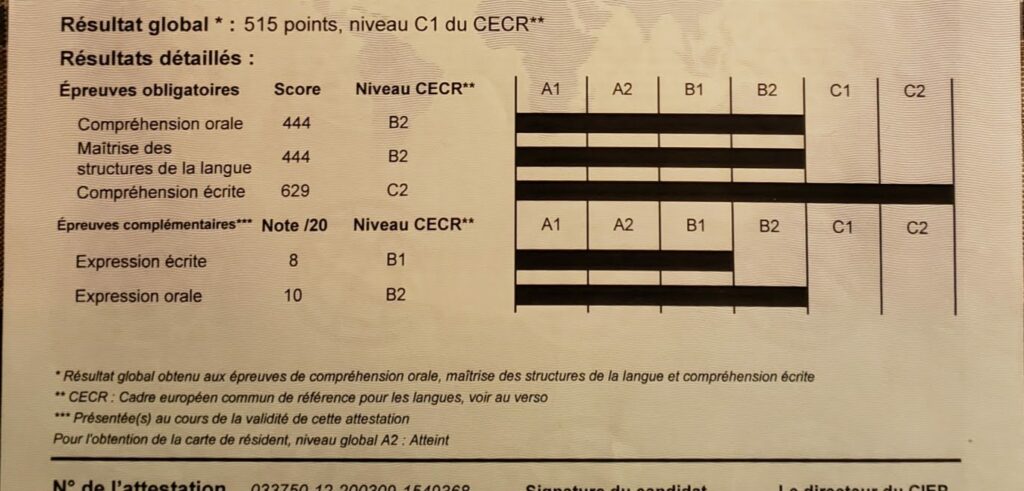
Your certificate is valid for two years from the date your results are issued. Only one official copy is produced, so keep it safe and make a copy immediately. You can retake the test as many times as you need, but you must wait at least 30 days between sessions.
Which Level Do You Need?
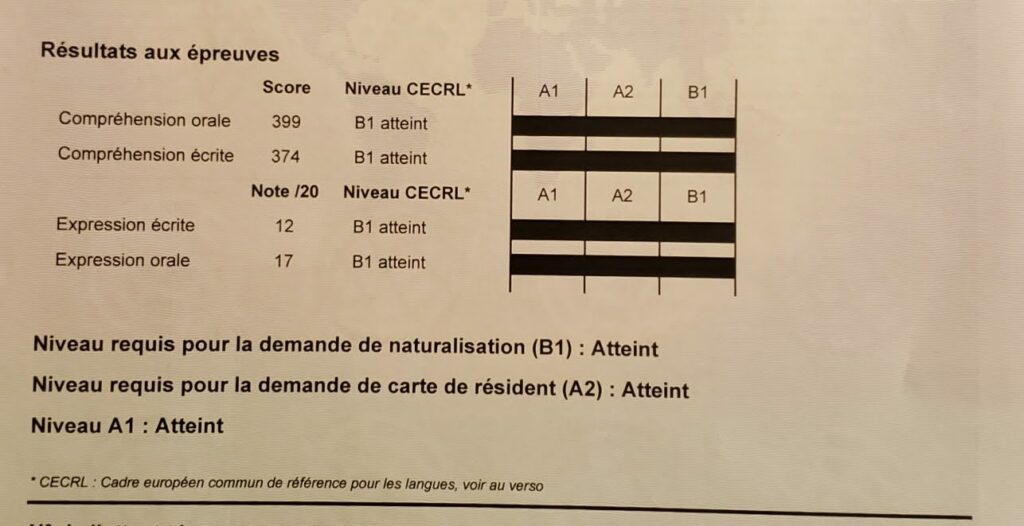
Since January 2026, the language requirements for French residency and nationality have changed significantly under the 2024 immigration law. Here is what is now required:
- A2: required to obtain a carte de séjour pluriannuelle (multi-year residency permit)
- B1: required to obtain a carte de résident (10-year residency card)
- B2: required to apply for French naturalisation
This is a notable shift. Before 2026, B1 was the threshold for naturalisation. B2 is now required. If you are planning ahead for nationality, aim higher than the minimum from the start.
A practical note on timing: your certificate is valid for two years. If you are planning to apply for naturalisation and your certificate expires before your dossier is submitted, you will need to retake the test. Factor that into your timeline.
TCF IRN vs DELF vs DALF: Which One Do You Need?
There are several ways to certify your French level, and which one you need depends on what you are applying for.
TCF IRN
This is the test to take if you are applying for a titre de séjour, carte de résident, or French nationality. It is offered regularly throughout the year, results come back within three to four weeks, and it is the most practical option for administrative purposes. The test now assesses up to B2 level, which covers everything up to the naturalisation threshold.
TCF TP
The general public version of the TCF. Used for professional, personal, or academic reasons rather than administrative ones. It tests up to C2 and covers five areas rather than four. If you want a broader language assessment or need a certificate for an employer, this is the version to consider.
DELF
The Diplôme d’études en langue française, organised by France Education International. Unlike the TCF, the DELF tests one specific level at a time: A1, A2, B1, or B2. If you pass, you receive a diploma that is valid for life — not just two years. That lifetime validity is a meaningful advantage if you are far from your naturalisation application and worried about expiry dates. The DELF B1 is accepted for carte de séjour applications, and the DELF B2 for naturalisation. The downside is that sessions are less frequent than the TCF.
DALF
The Diplôme approfondi de langue française, also by France Education International. This covers only C1 and C2 levels. Unless you specifically need to certify advanced proficiency, this is not the test most people in the immigration process will need.
How I Registered: ELFE, Paris
I took both my TCF TP (March 2020) and my TCF IRN at ELFE, the Ecole de Langue Française, located on Rue Montmartre near Châtelet Les Halles. I chose it because it was close to where I was living at the time and the registration process was straightforward.
Registration is done online in French, so a working level of the language is useful at this stage. Once you have selected your test type and filled out the form, you choose a date and time. You will need to provide photo ID front and back. After completing the form, you receive a confirmation and convocation by email, which you need to print and bring on the day along with your ID.
Note on price: When I registered the fee was 152€. It has gone up to 165€. Confirm the current price directly at elfe-paris.com before budgeting for this.
ELFE is not the only option. France Education International maintains a full list of accredited TCF centres across France and abroad. If you are not in Paris or prefer a different location, check france-education-international.fr for the centre nearest to you.
The Test Day: My Experience
I arrived at ELFE 15 minutes before my scheduled 9 AM start. There was a waiting room where we sat until the instructor came down. The registration process took about an hour — we were called up one by one to verify our details (name, address, email, phone number) and have our photo taken. That photo appears on your results certificate. I was very glad I had brought a book.
Once everyone was registered, we went up to the examination room. Personal belongings were locked away. You bring only your ID, headphones, and a pen. We sat at individual computers and plugged in.
The written and listening section covered reading comprehension, listening comprehension, and written expression. Each section was timed. Once time was called, you could not go back. There was some extra time built in at the end of each section to review your answers if you finished early. If you were confident, you could signal to the proctor to move on.
The oral section was individual, one on one with an examiner. There were three exercises. The first was a simple self-introduction — three minutes to talk about yourself. I rattled on and the examiner guided me when I lost my thread. The other two were dialogue-based: one involved asking a neighbour about watching my cat during a holiday, the other was booking a rental through an agency. The examiner was noting things throughout and grading on a form.
At the end I checked in with reception and was told results would arrive by email in three to four weeks. When they were ready, I went back in person to collect my certificate, showed my ID, signed a form, and that was that.
Tips for Test Day
- Print your convocation and bring it with you along with your photo ID.
- Bring headphones. They are required for the listening section.
- Bring a book or something to read. The registration process before the exam starts can take up to an hour.
- You cannot go back once a section closes, so use the review time at the end of each part.
- For the oral section: if you lose your train of thought, the examiner will prompt you. Do not panic.
- Only one copy of your results certificate is issued. Make a photocopy the moment you collect it.
- Results take approximately three to four weeks. Note that July and August sessions can take up to six weeks.
Resources
France Education International (TCF official info)
Find an accredited TCF centre near you
ELFE Paris (where I took my tests)
OFII Convocation Day One: Everything You Need to Know About the CIR


You May Also Like
What is a Contrat d’Intégration Républicaine?
17 January 2023
Your French Tax ID Number (Numéro Fiscal): What It Is and How to Get It
17 May 2021
One Comment
Pingback: