Maternity Leave in France: Your Guide to Congé Maternité

This post is part of my Pregnant in France series. Start with Just Found Out You’re Pregnant in France?
If you are pregnant and wondering how maternity leave in France actually works, you are in the right place. Congé maternité , French maternity leave, is one of the most generous in the world, but navigating it as an expat, especially in a second language, can feel overwhelming. This post covers everything: how long your leave will be, what you are entitled to financially, what documents are required, and exactly what to do and when.
Once your pregnancy is officially declared, Ameli (France’s health insurance system) will notify you of your maternity leave dates, calculating exactly when your leave will begin and end. If you are employed, you will need to inform your employer of these dates. From the moment your pregnancy is recognised, you gain certain workplace protections, including protection against termination and the right to take time off for medical appointments related to your pregnancy.
Table of Contents
Your employment contract is suspended during maternity leave because you are legally absent from your job for a protected reason: maternity. This suspension means that the performance of the contract is temporarily interrupted, but that the contractual relationship between you and your employer is maintained. In short, this is a legal measure that protects you while maintaining your link with your employer. Here are the main reasons for this suspension:
- Protection of the employee : The law guarantees a right to rest before and after childbirth to protect the health of both mother and child.
- Right to specific compensation: During maternity leave, the employee no longer receives the usual salary, but can benefit from daily allowances paid by Social Security (and possibly a supplement from the employer, depending on the applicable collective agreement).
- Continuation of employment contract: Suspension means that the employer may not terminate the contract (except for serious misconduct or the impossibility of maintaining the position for reasons unrelated to the pregnancy), which guarantees that the employee will return to her job or an equivalent position upon her return.
- Acquisition of certain rights: During this period, the employee continues to accumulate certain rights such as seniority and, depending on collective agreements, paid leave.
Length of Maternity Leave
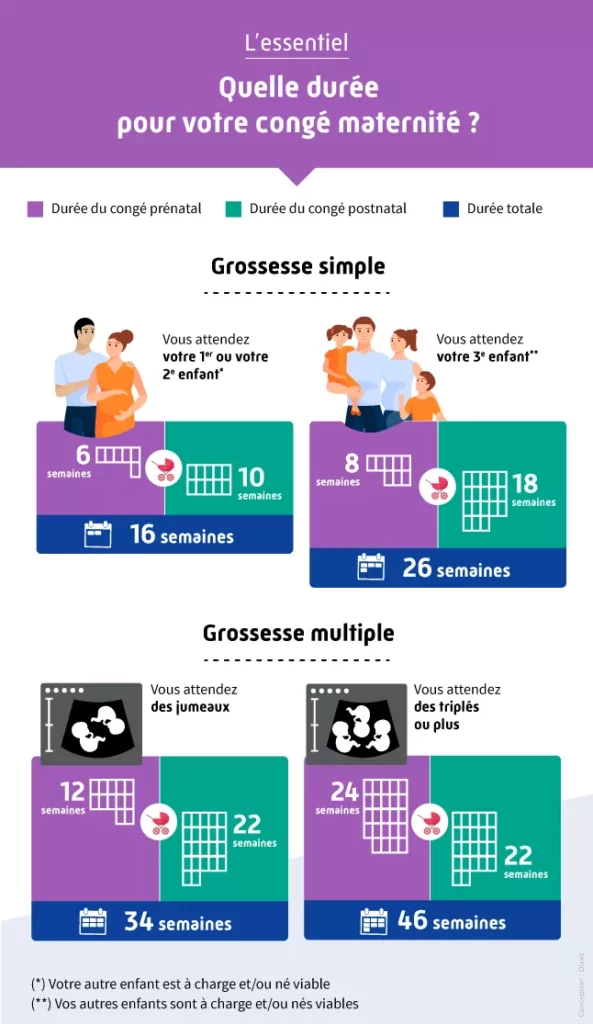
Depending on your family situation depends on how much time you are given off for maternity leave (the number of children you are expecting and the number of children you already have at home). The totality of maternity leave is split into 2 periods, prenatal maternity leave is the time before the child is born and postnatal leave is the time after the child is born. Here’s how it breaks down:
If you are expecting your first or second child
You are given a total of 16 weeks of maternity leave, where 6 weeks is taken before the due date and 10 weeks is taken afterward.
If you are expecting twins
A total of 34 weeks where 12 weeks is taken before the due date and 22 weeks after the calculated due date.
If you are expecting triplets
A total of 46 weeks, 24 weeks before the due date and 22 weeks after the calculated due date.
If you are expecting third child
A total of 26 weeks where 8 weeks is given before the due date and 18 weeks after the calculated due date.
There are certain instances where you can change the date(s) of your maternity leave. You can ask that a part of your prenatal maternity leave (the time before the due date) be moved to you postnatal maternity leave (the time after the due date). You can ask up to 3 weeks to me moved from the beginning of your maternity leave to the end. This is done through your CPAM and you’ll need a note from your healthcare professional stating that the state of your pregnancy allows you to make this change. This request will need be done no later than the day before the first day of the start of your maternity leave.
If your pregnancy is considered at-risk, you can request a congé pathologique. More on that below.
Informing your employer
You only need to inform your employer of the dates of the maternity leave either by LRAR or in person. You will also need to include the certificate of declaration that your health care professional established. You do not need to let your employer know about the state of your pregnancy. There are certain benefits that you can have once your employer is notified of your maternity leave.
You or your health care provider will inform the SECU during the declaration of pregnancy at the end of our first trimester (typically during the ultrasound).
Protection against discrimination while pregnant in the workforce
There are protections set up through the law that cover you during the length of your pregnancy, including before, during and after. You can benefit from stipulations of the Labour Code and the Penal Code concerning protection against discrimination.
You are entitled to take time off to attend any and all essential medical appointments during pregnancy and after childbirth.
If you are undergoing IVF, as laid out in the French Public Health Code, you are entitled to a leave of absence for the necessary medical procedures.
Your partner is entitled to attend a maximum of 3 essential medical appointments or medical procedures without a dock in pay.
Depending on your convention collective, collective bargaining agreements, you can benefit from flexible working hours and/or breaks if you are pregnant or having returned from maternity leave.
Getting reimbursed
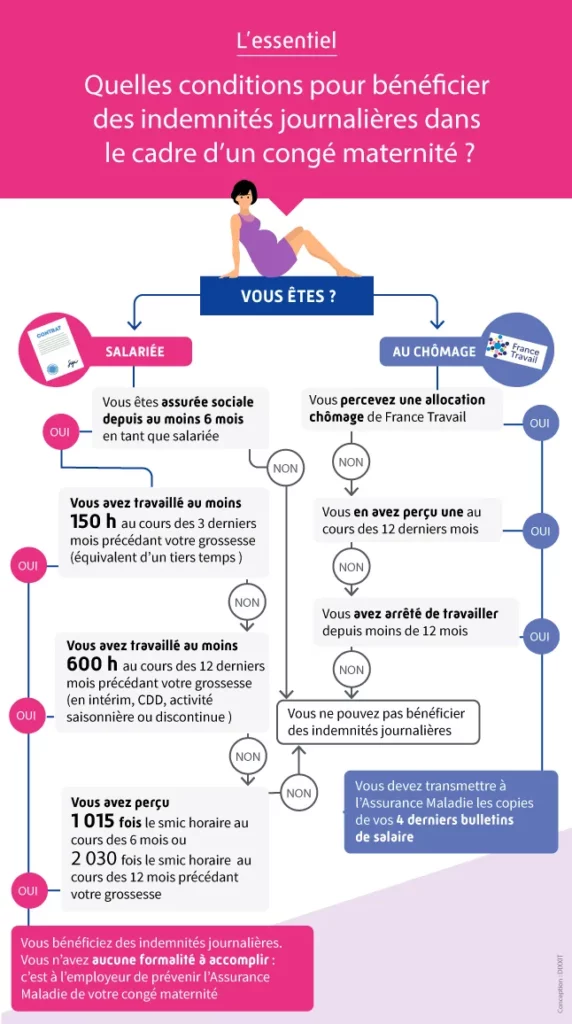
Depending on your professional position depends on how you will be reimbursed during your maternity leave (minimum period of affiliation, number of hours worked, amount of contributions paid, etc.). Some of these conditions are:
- have been registered with Assurance Maladie as an insured person working for at least 6 months on your expected delivery date (this is about your Social Security affiliation, not time with one employer).
- have worked at least 150 hours in the last 3 months before maternity leave.
- you received 1015 times the hourly pay rate in 6 months (2030 times the hourly pay rate in 12 months).
- if you work on fixed-term contracts, through temp agencies, or in seasonal or irregular work: at least 600 hours worked in the year before your leave starts.
You do not need to do any declarations on your end, it is your employer who will declare to Assurance Maladie your maternity leave.
Typically, your daily allowances during maternity leave is a percentage of your salary. There is a simulator that you can use to get an idea of what you will be paid out during your leave.
Your daily allowances will come from your CPAM and will be distributed about every 14 days. . You can check your Ameli account for the details of the payments. My maternity leave started on the 20th of September and I received my first payment on the 14th of October. Just be ready that it may be several weeks before you start receiving your money.
Your pay is calculated on the last 3 months pay before the start of your maternity leave. If you are a seasonal worker or in a non-continuous activity, it is based on the 12 previous month’s pay. The maximum daily amount you can receive is €104.02/day after 21% is taken out for social charges and taxes, calculated on a salary ceiling of €4,005 per month. Your daily allowances are calculated on your last 3 months of salary before the start of your maternity leave.
To find all the different instances you can receive pay during your maternity leave, you can see Ameli. This website is in French.
If you are on unemployment (chômage)
If you are on unemployment and you become pregnant, you can also be reimbursed daily for your maternity leave. You need to meet the following 3 conditions:
- Already enrolled and receive benefits from France Travail.
- Have received unemployment benefits in the last 12 months.
- Stopped working less than 12 months ago.
You will need to send copies of your last 4 pay slips to your CPAM. The calculation and dispensation of you daily allowances remain the same.
If you are self-employed (including auto-entrepreneur)
You receive a flat-rate rest allowance plus flat-rate daily allowances instead of salary-based ones. To receive the daily allowances, you must stop working for at least 8 weeks, 6 of them after the birth. Check Ameli for the current amounts.
Documents Required for Congé Maternité
One of the most common questions about maternity leave in France is what paperwork you need to submit and to whom. Here is the clear breakdown:
What you need to do:
- Declare your pregnancy to your CPAM and CAF before the end of the 14th week of pregnancy. This is the déclaration de grossesse and it is what activates your coverage and maternity benefits.
- Inform your employer of your maternity leave dates, either by registered letter (LRAR) or in person, along with the medical certificate establishing the dates.
What your employer does:
- Your employer sends your salary attestation (attestation de salaire) directly to the Assurance Maladie at the start of your prenatal leave. You do not need to do this yourself.
Key point: You do not need to submit any paperwork to receive your daily allowances. It is your employer’s responsibility to send the salary attestation to the Assurance Maladie. If your payments are delayed, check with your employer that this has been done.
For pathological leave extensions:
- A medical certificate from your doctor, gynaecologist, or sage-femme, sent within 48 hours to both your CPAM and your employer.
Congé Pathologique
This is a specific type of medical leave that can be prescribed during your pregnancy, up to 2 weeks in total, before your maternity leave starts. It is granted to pregnant women who experience medical complications related to their pregnancy. It provides additional time off work before maternity leave, in cases of medical necessity.
This leave is intended to protect the health of the pregnant woman when the pregnancy presents complications (excessive fatigue, hypertension, gestational diabetes, risk of premature delivery, etc.). The requirements of taking congé pathologique are granted exclusively on medical prescription by a general practitioner, gynecologist or midwife. up to 14 days before maternity leave starts, and up to 28 days after the birth. It must be justified by pregnancy-related medical complications. This leave is independent of maternity leave, but is often considered an extension of prenatal rest in case of need.
If you fit the case for congé pathologique, you will need a medical consultation to establish the medical leave by issuing a medical certificate stating the state of health justifying the leave. The medical certificate must be sent within 48 hours to the CPAM and the employer.
During this period, the employee receives daily allowances from CPAM which are calculated in the same way as for sick leave, without a waiting period. Some employers or collective bargaining agreements provide for a supplement to maintain salary.
Example of a situation where it is prescribed:
- A pregnant woman suffering from intense and persistent fatigue.
- A risk of premature birth requiring rest.
- A pregnancy complicated by hypertension or gestational diabetes.
This leave is a right, but subject to medical assessment. If you experience unusual symptoms or excessive exhaustion, don’t hesitate to talk to your health care provider.
Partner Leave: Congé de Naissance and Congé de Paternité
Your partner has their own leave around the birth. It is open to the other parent: the father, or your spouse, PACS partner or live-in partner. It comes in two parts. First is the congé de naissance: 3 working days right after the birth, paid by the employer, and compulsory. Then comes the congé de paternité et d’accueil de l’enfant: 25 calendar days (32 for multiples), paid by the Sécurité sociale. The first 4 days are compulsory and must follow straight on from the birth leave. The other 21 days (28 for multiples) are optional, can be split into two periods of at least 5 days, and must start within 6 months of the birth. Together that is up to 28 days around the birth, and the first 7 are compulsory.
Congé Supplémentaire de Naissance
This is a newer benefit worth knowing about: since July 1, 2026, France introduced a congé supplémentaire de naissance, adding one to two additional months of paid leave on top of existing maternity, paternity, and adoption leave. It’s available to any parent of a child born or arrived in the home from January 1, 2026 onward, and both parents can each claim it, simultaneously or one after the other, however works best for your family.
The leave has been accessible since July 1, 2026 and here’s how it works in practice:
- Length: 1 or 2 months per parent, and it can be split into two separate one-month periods rather than taken all at once.
- Timing: it can only be taken after you’ve used up your maternity, paternity, or adoption leave, and it must start within 9 months of the birth or adoption (this window is extended if your legal leave itself was extended, e.g. for multiples). If your child was born or arrived between January 1 and June 30, 2026, you can take it from July 1, 2026 and must start by March 31, 2027.
- Notice: you must tell your employer at least 1 month before it starts (15 days if it follows straight on from paternity, accueil, or adoption leave), and your employer can’t refuse the request.
- Eligibility: employees need 6 months of Social Security affiliation on the day the leave starts, plus either 150 hours worked in the previous 3 months or earnings of at least 1,015 times the hourly SMIC in the previous 6 months. Employees must also have taken their full maternity, paternity or adoption leave first.
- Pay: it’s funded by Social Security, not your employer, and paid on a degressive scale: 70% of your net salary for the first month, then 60% for the second, within the Sécurité sociale ceiling. The daily amount can’t exceed €72.81 in the first month or €62.41 in the second, and it’s paid after each period of leave ends, not during it. Self-employed workers receive a flat-rate daily allowance reduced in the same proportions.
One thing to plan around: you cannot combine the congé supplémentaire de naissance with PreParE (see below) for the same period, though the two can follow one another. If you receive PreParE or CMG, you must declare the daily allowances from this leave to your CAF, which suspends the payment during that period.
Congé Parental
Congé Parental, parental leave, allows a parent to suspend or reduce their professional activity after the birth or adoption of a child, in order to take care of the child. It can be taken by either the mother or the father, and extends over several months or even years, depending on the family’s needs. Parental leave enables parents to :
- Spend more time with their child after birth or adoption.
- Facilitate the balance between family and professional life.
- Postpone the return to work after maternity/paternity leave.
It can be a total suspension of employment contract or partial suspension with a reduction in working hours.
Conditions for parental leave are different depending on the type of sector you work in, meaning public or private. If you are a private-sector employee, meaning you do not work for a government agency, you must have at least 1 year’s seniority in the company at the date of the child’s birth or adoption. If you are a civil servant (public sector), parental leave is also possible, but subject to specific rules. If you are self-employed, you can benefit from specific aids such as the Prestation Partagée d’Éducation de l’Enfant (PreParE).
The duration of this leave can be taken until the child’s 3rd birthday (or 3 years after adoption). It is granted for periods of 1 year at a time and it is renewable. The second parent may also benefit, at the same time or alternately. You can ask for full-time or part-time leave; full-time leave in where a total suspension of employment contract and part-time leave with a reduction of working hours to 80%, 60%, 50% or other, as agreed with the employer. It is possible to convert full-time parental leave into part-time to gradually return to work.
To apply for parental leave, you must inform the employer at least 1 month before the end of the maternity/paternity leave or 2 months before the date on which the leave is taken if later. This is done by a registered letter with acknowledgement of receipt (LRAR) or a hand-delivered letter with signature. Here is a simulation provided by Service Public to write your letter to ask for congé parental.
Compensation and financial assistance during the parental leave is not paid by the employer but possibility of receiving the PreParE (Prestation Partagée d’Éducation de l’Enfant) which is paid by the CAF and is subject to resources and duration. There are some collective bargaining agreements that provide for additional benefits as well. You will need to check with them before deciding to take leave.
As of the April 1, 2026 revalorization, the PreParE amounts are as follows (net amounts after CRDS deductions):
- €459.69 for full parental leave (complete stop of activity)
- €297.17 for part-time parental leave, activity ≤50%
- €171.42 for part-time parental leave, activity between 50% and 80%
- €751.40 for the majorée rate, available from the 3rd child if you fully stop working, this comes with a shorter payment window
It can be paid to a single parent or to both, they can receive it successively or simultaneously, but in the latter case, the total combined amount cannot exceed the full-rate amount above.
If you are looking to renew or are coming up on the end of the leaven it can be renewed each year up to the child’s 3rd birthday. Your employer must be notified at least 1 month in advance of any return to work.
Examples of situations where parental leave is taken:
- A mother who wishes to stay with her children.
- A mother who wishes to stay with her child until he or she starts daycare.
- A father who wants to share the upbringing after paternity leave.
- A parent who cannot find suitable childcare immediately.
- A couple alternating periods of parental leave to maximize their time with the child.
FAQ
Do I have to take the full length of my maternity leave, or can I go back to work early?
No, you can waive part of your leave, but the law sets a hard minimum of 8 consecutive weeks off, including at least 6 weeks after the birth. This applies whether you’re an employee or self-employed, and your employer legally cannot let you return before that. The only exception is job seekers registered with France Travail, who must take the full leave.
Can I get maternity benefits if I'm a freelancer or auto-entrepreneur?
Yes. Since 2019, auto-entrepreneurs get the same leave lengths as employees, but the payment structure is different: you receive a flat-rate allocation forfaitaire de repos maternel (€4,005 in 2026, paid in two instalments) plus flat-rate daily allowances, as long as you’ve been affiliated for at least 6 months and fully stop working for the mandatory 8-week minimum. If your average annual revenue is under €4,582, these amounts are reduced to 10% of the standard rate.
What's the difference between congé parental and congé supplémentaire de naissance?
Congé parental is the long-term option, up to the child’s 3rd birthday, largely unpaid beyond the modest PreParE allowance. The congé supplémentaire de naissance is new, short, and better paid: 1–2 months right after your maternity/paternity/adoption leave, at 70% then 60% of your salary. Many families use the congé supplémentaire de naissance first, then move into congé parental if they want more time off after that.
Can both parents take the congé supplémentaire de naissance at the same time?
Yes, each parent has their own individual entitlement of 1–2 months, and you can take it simultaneously or stagger it between you, whichever suits your family better.
Can I combine PreParE with the congé supplémentaire de naissance?
Not for the same period, you can’t draw both at once. You can, however, take them one after the other: most families use the better-paid congé supplémentaire de naissance first, then transition into congé parental and PreParE if they want to stay off longer.
Can I move part of my prenatal leave to after the birth?
Yes, up to 3 weeks. You’ll need a note from your healthcare provider confirming your pregnancy allows it, and the request has to go through your CPAM no later than the day before your prenatal leave was due to start.


You May Also Like
Feuille de Soins in France: What It Is and How to Use It
12 September 2025
Carte Vitale in France: How to Get Yours as a Foreigner
19 November 2025
One Comment
Pingback: