How to Renew Your VLS-TS in France: The Complete Guide
Application to renew my VLS-TS for the first time
When I went through this process in 2020, it meant navigating the préfecture in person, paper dossiers, and waiting rooms. That process no longer exists for VLS-TS renewals — it has moved entirely online through the ANEF portal. My original experience is preserved throughout this post where it is still relevant, but the step-by-step process reflects how it works today.
When your VLS-TS is approaching expiry and you start looking for information on how to renew it, you quickly discover that France does not exactly send you a helpful reminder letter. There is no email, no text, no knock on the door. You are simply expected to know what to do and when.
This post covers the complete renewal process for a VLS-TS vie privée et familiale as a spouse of a French national — when to file, what documents you need, how the ANEF online system works, and what to expect while you wait. It also includes my original experience from 2020, when the process still involved a physical préfecture appointment, as context for how much things have changed.
What You Are Renewing and Why It Matters
Your VLS-TS, visa long séjour valant titre de séjour, is the long-stay visa that served as your initial residence permit after arriving in France. After validating it with OFII and completing your first year, you are eligible to renew it as a carte de séjour temporaire (one year) or, under certain conditions, a carte de séjour pluriannuelle (multi-year).
For spouses of French nationals, the renewal is filed under the mention vie privée et familiale (VPF). This permit authorises you to reside in France and to work, your employer does not need to apply for a separate work authorisation.
Fee reminder: From May 1, 2026, the first renewal costs €200 (unchanged) plus a timbre fiscal of €50, for a total of €250. File before May 1 if your renewal is coming up to avoid the timbre fiscal increase.
When to File
This is the single most important thing to get right. File too early and your application may be rejected. File too late and you face a late filing penalty and potential complications with your legal status.
Important: You must file your renewal between 4 months and 2 months before your titre de séjour expires. Filing later than 2 months before expiry incurs a late penalty fee of €180. Do not leave this until the last minute.
If your previous titre de séjour was issued through ANEF, you will receive an email and SMS alert as your expiry date approaches. If it was issued before ANEF existed,as mine was in 2020, you will not receive any automatic reminder and it is entirely your responsibility to track the date.
My experience (2020): My visa expired on 3 March 2021. I applied on 25 November 2020, just over 3 months before expiry. The paperwork I received with my original visa said to apply within two months of expiry, which was wrong. I should have started the process at the end of September. I ended up with an appointment 7 days before my visa expired, which was far too close for comfort. Start early.
How to File: The ANEF Online Process
The renewal process for spouses of French nationals is now entirely online through the ANEF, Administration Numérique pour les Étrangers en France. You do not go to the préfecture to submit documents. You do not send anything by post. Everything is done through your ANEF account.
Step 1: Create or access your ANEF account
Go to the ANEF portal and log in with your France Connect credentials, or create an account if you do not already have one. France Connect uses your tax account, Ameli account, or other official French digital identity to verify who you are.
Once logged in, your existing titre de séjour and personal information should be pre-populated in your account if your previous title was issued or renewed via ANEF. If it was not, as is the case for titles issued before ANEF launched, you will need to enter your details manually including your AGDREF number.
Your AGDREF number: This is the 10-digit number assigned to you when you validated your VLS-TS on arrival in France. It is not your visa number, it is the number on your OFII validation certificate. This number follows you through every French administrative procedure and you will need it for ANEF. Keep it somewhere safe.
My experience (2020): When I made my appointment in 2020, I got stuck because I thought they wanted my visa number, not my AGDREF. Once I found the right number, on the paperwork from when I validated my visa after arriving, it was straightforward. Think of it as the French equivalent of a Social Security number for foreign nationals.
Step 2: Select your renewal type
In your ANEF account, navigate to “Demande de titre de séjour” and select the renouvellement option. Choose “Vie privée et familiale – famille de Français” and then “conjoint de Français” as your specific situation.
Step 3: Upload your documents
ANEF will prompt you to upload each required document as you work through the application. Scan or photograph everything clearly, illegible documents are one of the most common reasons for requests for additional information (demandes de compléments) which delay your application.
Document requirements for common file formats: PDF is preferred. Maximum file size per document is typically 5MB. Each document should be uploaded separately, do not combine multiple documents into one file unless specifically asked to.
Step 4: Submit and receive your attestation de dépôt
Once all documents are uploaded and you have verified your information, submit your application. You will immediately receive an attestation de dépôt, a digital confirmation that your application has been received. Download and save this immediately.
✏ Updated: The ANEF process no longer issues a physical récépissé at submission. You receive a dématérialisée attestation de dépôt in your ANEF account. This document has the same legal value as a récépissé and allows you to continue living and working in France while your application is processed.
Documents to Prepare
The documents required for a VPF renewal as a spouse of a French national are consistent, but the préfecture has some discretion in what they ask for. The most scrutinised element is always the proof of communal life, you are not just renewing an administrative card, you are proving your shared life together is still real and ongoing.
Document | Notes |
Valid passport + copy of ID page | Copy of the page with your photo and personal details |
Copy of your current VLS-TS or titre de séjour | Both sides if applicable |
Copy of entry stamp page |
|
Copie intégrale de l’acte de mariage | Your French marriage certificate from the transcription |
Copy of pages from livret de famille | Wedding page and any children’s pages |
ID card of your French spouse | Copy of both sides |
Proof of communal life — minimum 4 documents | See note below — this is the most scrutinised part of the dossier |
Déclaration sur l’honneur conjointe | Signed by both spouses, attesting to shared life together |
Proof of address | Utility bill, rent receipt, or tax bill in both names or in your name |
3 ID photographs | Standard French ID photo format |
Tax documents / avis d’imposition | Last available tax return if applicable |
Attestation de droits Ameli | Download from your Ameli online account |
RIB (bank account details) | Ideally in both names |
Recent pay slips (last 3 months) | If employed — useful even if not on the official list |
The communal life documents: the most important section
This is where most applications run into complications. You need to demonstrate that you and your French spouse are living together, and the préfecture wants to see this confirmed through multiple independent sources. The standard expectation is four documents that together prove communal residence:
- Two documents confirming you both live at the same address, a joint lease or utility bill in both names, a joint bank statement, etc.
- One document confirming your individual residence at that address
- One document confirming your spouse’s individual residence at that address
My experience (2020): At my 2020 appointment, my quittance de loyer was not accepted as proof of communal life even though my name was on it. The agent asked for the last two years of joint tax returns, which I did not have since I had not been in France for a full year. She also asked for my attestation de droits from Ameli, which I had not thought to bring. Fortunately I had my RIB in both our names, my last two pay slips, and an internet bill in my husband’s name. Four documents was the magic number. Prepare more than you think you need.
Tip: Download your attestation de droits from your Ameli account before you submit. It is one of the most frequently requested documents and it is easily accessible online at any time from your Ameli account under “Mes documents”.
After Submitting: What Happens Next
Once your application is submitted on ANEF, it goes to your local préfecture for review. Processing times vary significantly between préfectures and can range from a few weeks to several months. Paris and Île-de-France tend to have longer processing times than other regions.
While your application is being processed:
- Your attestation de dépôt allows you to continue living and working in France legally. Keep it with you.
- You can track the status of your application in your ANEF account.
- If the préfecture needs additional documents, they will send a demande de compléments via your ANEF account or by email. Respond promptly, slow responses can delay your card significantly.
- If your application is approved, you will receive a notification to come to the préfecture to collect your card and pay the timbre fiscal.
When you are notified your card is ready, you will typically need to book an appointment online to collect it at your local préfecture. You will pay the timbre fiscal at this appointment, for most renewals this is €50 from May 2026, previously €25.
My experience (2020): After my in-person appointment at the préfecture in 2020, in the 9th arrondissement, metro Barbes, I was told my card would be ready within two months and I would receive a text message with a link to book a collection appointment. I had my récépissé in hand when I left the building and finally breathed properly for the first time in weeks. The staff were short but professional. I came over-prepared and it paid off.
What to Do if ANEF is Not Working
ANEF has a reputation for technical issues, and this is one of the most common frustrations for people trying to file their renewal. Here is what to do if you encounter problems:
- Try a different browser, Chrome tends to work more reliably than Safari or Firefox for ANEF.
- Make sure your browser does not have a language translation plugin activated. This can cause technical difficulties.
- Try at a different time of day, the platform can be slow during peak hours.
- Contact the Centre de Contact Citoyen (CCC) at 08 06 00 16 20 (free call from a landline or mobile with free landline minutes). This is the official support line for ANEF.
- Visit the point d’accueil numérique at your local préfecture, where staff can assist you in person with the ANEF submission. You can book this appointment through your préfecture’s website.
⚠ Important: Do not miss your filing window because of ANEF technical issues. If you are unable to file online close to your deadline, contact your préfecture directly and document your attempts. A late filing penalty of €180 can sometimes be waived if you can demonstrate the delay was caused by a platform failure.
Lessons Learned: What I Would Do Differently
Having gone through the old préfecture process in 2020 and having watched the system evolve significantly since then, here is what I would tell anyone starting their renewal today:
- Start 4 months before expiry, not 2. This gives you time to gather documents, deal with ANEF technical issues, and respond to any requests for additional information without stress.
- Gather more proof of communal life than you think you need. Four documents minimum, ideally five or six from different sources. Joint tax returns, joint bank accounts, utility bills, rent receipts, attestation de droits, and pay slips from both of you.
- Download your attestation de droits from Ameli before you file. It will likely be asked for and it takes two minutes to get.
- Save your AGDREF number somewhere permanent and accessible. You will need it for every French administrative procedure for the rest of your time in France.
- Keep every document from the process, attestations, receipts, correspondence from the préfecture. French administration has a way of asking for things you were told you would not need.
- Be over-prepared rather than under-prepared. In French administration, having a document you do not need is never a problem. Not having one that is asked for can cost you the appointment.


You May Also Like

Pregnant in France : First Steps, Declaration & What to Expect
2 October 2024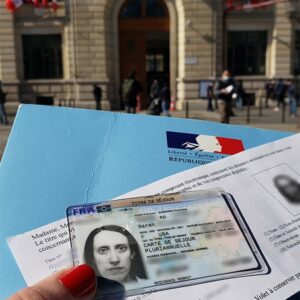
Picking Up Your Carte de Séjour in France
14 May 2021
3 Comments
Pingback:
Pingback:
Pingback: