Raising a Bilingual Child in France: What Actually Works
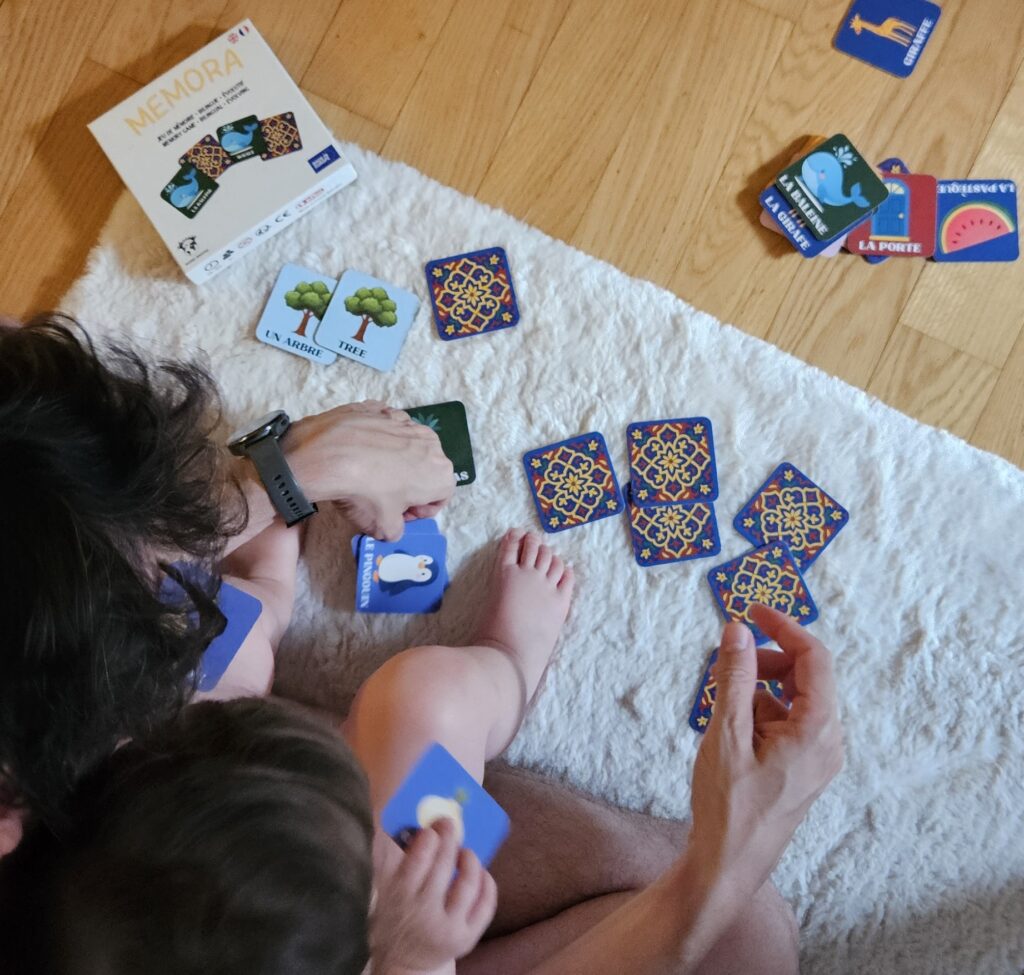
I’m always amazed at how my daughter is picking up words and phrases at the moment. She is in full sponge monde and I love watching her little face as her brain works hard to make connections. She tries to repeat everything I say and as her little mouth fumbles, she looks at me quizzically.
Repetition has been the name of the game recently, I say a word slowly and she tries to repeat it back. She has her favorite words at the moment: bateau, escargot (which comes out as argo), cheese and il est là.
This post is done in partnership with Word Bridge. I received their bilingual parenting guide for free in exchange for an honest review, no affiliate commission involved. I genuinely love what they’ve built. Everything below reflects my real experience with my own daughter.
Our Version of OPOL
I speak English with my daughter as much as I can. My husband and I speak French at home, but I’ve been trying to speak more English even with him around. There are times when we’re out, like on a recent trip to Strasbourg, where I need to speak French and I do that without hesitation. I think it’s important that she also hears me speaking French, because that’s the language that we live in.
One thing that surprised me is that there are moments when I need to reprimand her and I’m quicker to respond in French than in English. I don’t know if that has an impact, if she picks up on the fact that I sound more serious when I switch, but it’s an instinct I’ve noticed in myself more than once.
The Assistante Maternelle Transition (and the School Question)
We won’t be in a crèche, my daughter has started with an assistante maternelle, so I can’t speak yet to how full-time care outside of our home will shift her language balance. What I have noticed already, even before care started, is that she’s saying more French words than English ones. That’s completely fine with me, it’s the language we live in and I fully expect her to speak French before she speaks English.
It’s a fork in the road that a lot of expat/immigrant families in France reach: do you send your child to a English-speaking or international shool, prioritizing English now and trusting French will come later through daily immersion? Or do you go the French public school route from the start?
For us, the choice was more logistical than philosophical. I went to Catholic private school growing up and my husband too; private education wasn’t a foreign concept to either of us. But we didn’t seriously consider an international of English-speaking school for Laura, at least not at this stage. She’s bilingual from birth, I speak English with her, my husband speaks French, and French is simply the language she hears and sees the most, since it’s the language of daily life around her. Putting her in a French-speaking setting for school just followed logically from that.
That’s not a permanent decision, if Laura wants an international or English-speaking school later, that’ll be her call to make. For now, French public school is the right fit for where she is.
Where Memora Fits in and What it Looks Like at 22 Months
Memora is technically rated for ages 3 and up; Laura is 22 months. We decided to start anyways with the game as she was showing signs that she could handle the game. We just take it in smaller doses. What signaled to us that she was ready was the books, honestly. She started pointing at images, attempting to say the word, trying to repeat what we were saying. She didn’t get it perfect, she has her own little accent, but she gets it. As time went on, she was able to figure it out quicker.
I pull 6 cards (3 pairs) from the Memora deck and we play a scaled-down version, not the full memory game, just the matching and naming. The moment it clicked for me was the first time she matched the French and English cards correctly. That was the moment that I knew this wasn’t just repetition anymore, she was actually understanding.
What’s interesting is the pattern that’s emerged since, I ask her about the cards in English and she answers in French every time. It doesn’t bother me. She understands the question either way, the response just comes out in the language she reaches for first, which tracks with everything else I am seeing. French is where her mouth and brain go, even when English is where the question is from.
What’s Kept this from Being Hard
If I am being honey, we haven’t hit a real struggle yet and I credit that to mostly preparation before hand, not luck.
Before Laura was born, we made the point of understanding what bilingual development actually looks like, the code-switching, the uneven pace between languages, the fact that one language almost always leads. Knowing that ahead of time meant when I saw exactly those things start to show up, I recognized them as normal instead of worrying something was going wrong.
Word Bridge’s guide reinforced a lot of that. Reading through it felt less like learning something new and more like getting confirmation: what we’re expecting, the French dominance, the code-switching, the early Memora session, is developmentally exactly where she should be.
That’s not to say it may not get harder later. The assistante maternelle transition might be the first real test, but going in informed instead of anxious has made all the difference so far.
One Word at a Time
You won’t remember most of what’s in a parenting guide a year from now, but what you will remember is the park in the morning, the same board book for the 10th time, the 6 cards spread out on the floor while she matched bateau to boat and says it back to you in a language you didn’t grow up speaking
That’s really the whole thing.
If you want to go deeper, Word Bridge’s Complete Family Bilingualism Guide walks you through the everyday habits that support bilingual development: the pillars, the common mistakes, and a full section for parents who don’t speak their child’s second language themselves. And it doesn’t matter where you are at in your bilingual journey, the guide is packed full of useful information for whatever step you are at.
And if you want to bring some of what we do at home into yours, Memora is the bilingual memory game we’ve been playing with Larua, matching, naming, building vocaublary one card at a time. We started earlier than the recommended age and scaled it down and it’s become part of our daily rhythm.
Languages available: English/French, French/Turkish, and on pre-sale French/Spanish
If Memora becomes part of your routine, Word Bridge has a few other things worth knowing about. Both are currently in pre-sale, with delivery expected end of September 2026.
The 7 Familles Bilingue Français-Anglais (€14.90) is a bilingual take on the classic French card game, 42 illustrated cards across seven themed families, designed for kids four and up.
For older kids and adults, their bilingual crossword puzzles (€12.90) mix French and English within the same grid, 35 puzzles, over 700 words, with difficulty that increases as you go. It’s aimed at ages twelve and up, but honestly, I think it’s a great fit for adult expats too, anyone brushing up on their French while living here, not just kids learning a second language. I haven’t tried it myself yet, but it’s on my radar.
You can visit their store here to check out all the items that they offer.
Will my child go through a silent period?
Maybe, maybe not, every child is different. At 22 months, Laura hasn’t gone through one yet, she’s saying single words but not full phrases and she’s responding to both languages without hesitation. Silent periods are more commonly discussed around the toddler-to-preschool stage or when a child starts full-time childcare in a new language. If it happens for us once she starts with her assistante maternelle, that’s normal too.
Is it confusing for a child to hear two languages at once?
No. What looks like confusion, mixing English and French in the same sentence, is actually a skill called code-switching. It shows a child knows which language to reach for, depending on who they’re talking to or what they’re describing.
What if one parent doesn't speak the minority language fluently?
It’s not a requirement; what matters most is consistency and richness of exposure, not fluency. A parent who doesn’t speak the second language can still shape the environment, choosing books, playing music, being present during language moments, or simply showing that the language matters in the family.
Does it matter if my child answers in a different language than I asked?
Not in my experience. I ask Laura questions in English and she answers in French almost every time. She understands both, the response just comes out in whichever language she reaches for first. That’s common, especially when one language dominates her daily environment.
Should I choose a French school or an English-speaking/international school for a bilingual child?
It depends on your family’s situation and goals. Some expat families choose English-speaking or international schools, prioritizing English now and expecting French to develop through daily immersion. Others choose the local public school system so the child is fully immersed in the language they’re already living in. Neither is wrong, it’s a matter of what fits your child’s environment and your long-term goals.
Is it too early to start language-learning games like Memora?
Officially, Memora is recommended for ages three and up. We started at 22 months, in a scaled-down form, six cards instead of the full deck, simple matching and naming rather than the full memory game. If your child is engaged, there’s no harm in adapting a game to a younger age. If you have any questions, please reach out to Word Bridge for any questions.


You May Also Like