The French Dossier: What It Is and What You Need
Before I even moved to France, I knew that having my paperwork in order was going to be non-negotiable. French administration runs on documents. Every appointment, every application, every administrative step comes with a request for papers, and if you show up without the right ones, you leave empty-handed and come back another day.
A dossier is simply your collection of personal documents, organised and ready to present whenever French bureaucracy comes calling. It is not a uniquely foreigner thing, French people maintain them too, but as an immigrant you will use yours more intensively, especially in your first year. Here is what you need to know.
Table of Contents
What Is a French Dossier?
A dossier is a collection of documents about your personal situation, proof of identity, proof of residence, financial records, civil status documents, and anything else that demonstrates who you are and how you are established in France. Think of it as a paper version of your life: more comprehensive than a CV, more personal than a contract.
Your dossier grows with you. When you first arrive it might be a thin folder of passport copies and a lease agreement. By the time you are applying for a carte de résident or French nationality, it is a substantial file spanning years of administrative history. The key is building the habit of keeping it current from the start.
When Do You Need One?
Dossiers are required across a wide range of situations in France, not just for immigration purposes. Here are the most common:
- Applying for a visa or titre de séjour
- Renewing a residency permit
- Applying for sécurité sociale or the carte vitale
- Getting married or signing a PACS
- Renting an apartment
- Opening a bank account
- Applying for French nationality
- Enrolling in an educational program
- Exchanging a foreign driving license
Each situation has its own specific document requirements, but most draw from the same core set of papers. Building a solid foundation means you are rarely starting from scratch.
The Core Documents Every Dossier Needs
Whatever you are applying for, these are the documents that appear on almost every list:
- Valid ID: passport, carte de séjour, or EU ID card depending on your situation.
- Proof of address: French administration strongly prefers utility bills, electricity or internet bills are the gold standard. A rental contract or home insurance certificate also works. Must typically be dated within the last three months.
- Recent pay slips: the last three months is standard. Keep these updated monthly.
- RIB (releve d’identité bancaire): your French bank account details. Every French bank account comes with a RIB document, download a fresh one from your banking app when needed.
- Tax return (avis d’imposition): your most recent one is usually sufficient, though some applications ask for two or three years. Download from your impots.gouv.fr account each autumn when it is issued.
- Birth certificate: almost always required, especially as a foreigner. Your US birth certificate will need an apostille to be valid in France. See the note on apostilles at the end of this post.
Additional Documents Depending on Your Situation
Beyond the core documents, you may need any of the following depending on what you are applying for:
- Employment contract: CDI (permanent) contracts carry significantly more weight than CDD (fixed-term) contracts in France. If you have one, include it. It is as close to a golden ticket as French administration offers.
- Attestations and sworn statements: these come in many forms, from your employer confirming your employment, from a landlord confirming you live with them (attestation d’hebergement), or from yourself declaring your personal situation.
- Marriage certificate: the French version (acte de mariage) is required for most administrative processes if you are married to a French national. I include mine as a matter of course.
- Livret de famille: the French family record book. If you have one, photocopies of the relevant pages are often requested.
- Passport photos: keep a small supply on hand. Residency permit applications, driving license exchanges, and various other processes require them.
- Translated documents: any non-French document (US birth certificate, diplomas, foreign marriage certificates) may need to be translated by a traducteur assermanté, a certified sworn translator. Do not leave this to the last minute as it takes time and costs money.
Dossiers for Specific Situations
Each major administrative process has its own specific document requirements on top of the core list. Rather than duplicating the full details here, I have written dedicated posts for the situations most relevant to Americans navigating life in France.
Marriage Dossier
Getting married in France, or to a French national, involves a specific set of paperwork that needs to be assembled before you can even apply for the certificat de capacite a mariage. This is a process I went through myself and it needs to happen in a specific order before the visa application.
Visa Dossier
The documents required for a long-stay visa depend entirely on which visa category you are applying for. I have covered the VLS-TS spouse visa in detail, the paperwork, the timeline, and what to expect at each stage.
Rental Dossier
Finding an apartment in Paris is its own sport, and the rental dossier is one of the most stressful parts of the process. French landlords and agencies have specific expectations about what constitutes an acceptable application, and missing a document can cost you the apartment.
Bank Account Dossier
Opening a French bank account as an American comes with its own quirks — FATCA compliance, W-9 forms, and the occasional banker who has never dealt with a US client before. I got lucky with La Banque Postale, where Thomas already had an account, and the process was relatively straightforward. The key documents are proof of identity, proof of address, and your titre de séjour or visa.
How to Keep Your Dossier Organized
The organization system you use matters less than the fact that you have one and actually maintain it. Here is what works for me.
Physical organisation
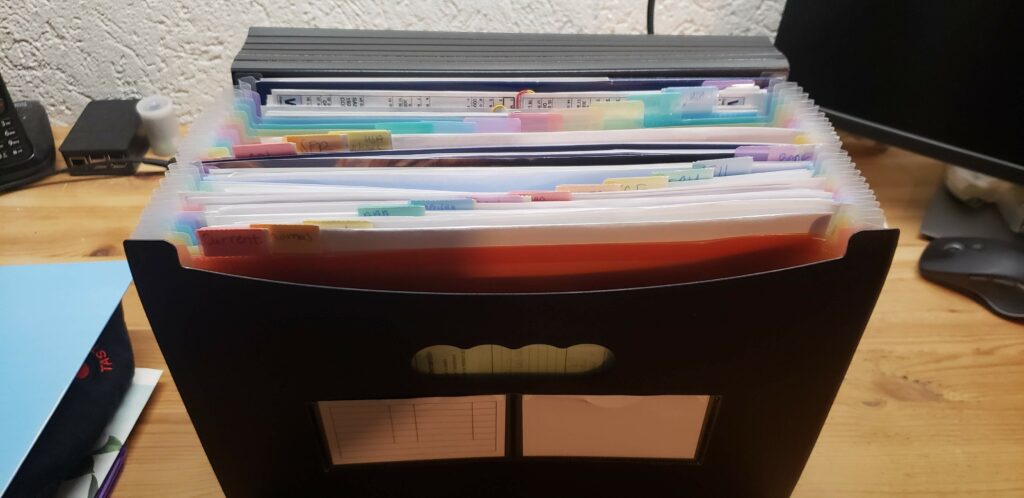
I started with a small portable accordion file folder with 12 slots, each labelled by category, identity documents, housing, banking, tax, employment, medical, and so on. Once I outgrew it I upgraded to a larger version. Every section has a label and contains only documents relevant to that category.
I also keep copies of certain documents that belong to my husband Thomas, because you never know what will be asked for at any given appointment. Finding out you need your spouse’s documents when you are already sitting across from an official is not a situation you want to be in. Trust me, been there, done that, do not recommend.
Binder clips, paper clips, and Post-it notes are your nouveaux amis. Label the documents you think they might ask for and have them easily accessible, fumbling through a disorganized folder at an appointment is stressful and makes a poor impression.
Digital organization
I keep a parallel digital record of everything in a Google Drive folder, which I have shared with specific family members. This is genuinely useful, Thomas can access my documents from his phone when we need to submit a rental application quickly, and if anything is ever lost or damaged, I have a backup.
The digital system means the physical file only needs to house original and certified documents. Everything else lives in the cloud and gets printed when needed.
Keeping it current
I spend about one day a month updating and reorganizing. Or at least I try. It falls around payday, which makes it easy to remember. New pay slips go in, old ones move to the back, the avis d’imposition gets updated in autumn when it is issued. The last thing you want is to discover your proof of address is six months old when you are sitting in an appointment that requires documents from the last three months.
A Note on Apostilles
If you are an American living in France, you will need an apostille on your US birth certificate and possibly on other official US documents. An apostille is a certification issued by the relevant US state authority (typically the Secretary of State’s office) that authenticates the document for use in countries that are signatories to the Hague Convention, which includes France.
France does not accept a plain US birth certificate as a verified document. It needs the apostille attached. If you have not already done this, request one from the Secretary of State’s office in the state where you were born. Processing times and fees vary by state. Do this early, it is one of those things that becomes urgent at the worst possible moment if you leave it too late. If you have any trips planned back home, I highly recommend obtaining any and all apostilles then. You can usually find an appoint quicker in person.
What is a dossier in French?
In French, a dossier is a file or collection of documents relating to a specific person or subject. In an administrative context, which is how most people encounter the word, it refers to the organized collection of personal documents you present when applying for something: a visa, an apartment, a bank account, a residency permit. Think of it as your paper identity: proof of who you are, where you live, how you earn money, and how you are established in France.
What documents do I need for a French dossier?
The exact list depends on what you are applying for, but almost every French dossier requires the same core set: a valid ID (passport or carte de séjour), proof of address dated within the last three months, your three most recent pay slips, a RIB (your French bank account details), and your most recent tax return (avis d’imposition). For foreigners, a birth certificate with apostille is also almost always required. Depending on the situation, you may also need employment contracts, sworn statements, marriage or birth certificates, or passport photos.
Do I need a dossier as a foreigner in France?
Yes, and you will use it more frequently than most French people, especially in your first year. Every major administrative step as an immigrant involves presenting documents: validating your visa, registering with Assurance Maladie, opening a bank account, renting an apartment, renewing your titre de séjour. Building and maintaining a well-organized dossier from the moment you arrive will save you significant time and stress at every one of these steps.
What is an apostille and do I need one in France?
An apostille is a certification that authenticates an official document for use in another country. France is a signatory to the Hague Convention, which means it requires foreign official documents, including US birth certificates, to carry an apostille before they are accepted as valid. If you are an American living in France, you will almost certainly need an apostille on your birth certificate. Request one from the Secretary of State’s office in the state where you were born. Processing times and fees vary by state, so do this well in advance of any application that requires it.
How do I keep my French dossier organised?
The system that works for me is an accordion file folder with labelled sections for each category, identity, housing, banking, tax, employment, medical. I keep originals in the physical folder and digital copies of everything in a Google Drive folder shared with my husband. Once a month, around payday, I spend about an hour updating it, new pay slips in, expired documents out, fresh proof of address filed. The goal is never to be caught at an appointment with documents that are out of date or missing.
How long does it take to put a French dossier together?
The core documents, ID, proof of address, pay slips, RIB, can be assembled in an afternoon if you are organized. The parts that take longer are the ones that require third parties: getting a birth certificate apostilled by a US state authority can take several weeks, and having foreign documents certified by a sworn translator (traducteur assermenté) takes time and needs to be planned in advance. Start building your dossier as soon as you know you are moving to France, and tackle the apostille and translation requirements early.


You May Also Like

How to Set Goals in France (& Why French Bureaucracy Forces You To)
8 January 2026
Apartment Hunting in Paris: A Guide for American Expats
22 April 2021
4 Comments
Pingback:
Pingback:
Pingback:
Pingback: